Events

Views Navigation

Today
  • LOCOS Seminar – Sylvia Wenmackers: “A Philosophical Exploration of Frugal Computing”

    LOCOS
    Online
    Virtual Event

    LOCO Seminar Sylvia Wenmackers: "A Philosophical Exploration of Frugal Computing" In response to the unsustainable rise in materials and energy required for current and projected computations, Vanderbauhede (2021) argued that we urgently need to adopt a more frugal approach to computing. To develop this proposal, this talk explores related ideas from economics and philosophy. For instance, Schumacher’s (1973) Small Is Beautiful gave rise to the notion of ‘appropriate technology’, which suggests supplementing frugal computing with a people-centered focus. In addition, environmental virtue ethics can be used to refine a question that frugal computing already poses: in light of human flourishing, which computations are worth doing in the first place? Finally, we may wonder whether the study of what needs to be done should ever take precedence over the investigation of the facts themselves. Vermeersch (2001) argued that our current environmental problems do indeed warrant such priorities.


  • CSA Africa Showcase 2025

    University of Glasgow, School of Computing Science Room 423, Sir Alwyn Williams Building, Lilybank Gardens, Glasgow

    CSA Africa is a transformative international outreach initiative under the School of Computing Science. Founded by Dr. Sofiat Olaosebikan, the initiative is driven by her personal journey of overcoming limited access to computing education in Nigeria to become an academic in the field. Her story fuels our commitment to bridging the tech education gap across Africa, ensuring that young Africans have the opportunity to build successful careers in technology. Please join us for an inspiring session showcasing how CSA Africa is empowering the next generation of African tech talent.

  • SICSA Education Seminar – Pedagogical Prompt Engineering Protocol Applied to LLM Feedback in Introductory Programming

    University of Glasgow, School of Computing Science Room 423, Sir Alwyn Williams Building, Lilybank Gardens, Glasgow
    Hybrid Event

    Please register to attend in person or online. Venue: Room 423, Sir Alwyn Williams Building, Lilybank Gardens, School of Computing Science, University of Glasgow Join us for the last SICSA Education Seminar of 2025 on 15 December at 2pm where University of Glasgow doctoral candidate Eyman Alyahyan will present her work:  A Pedagogical Prompt Engineering Protocol Applied to LLM Feedback ... Read more

  • Co-Production “The Real PPI”: Launching The Researcher’s Toolkit

    Co-production is a collaborative approach to research, where people with both lived and learnt experience work together to conceptualise, conduct and disseminate research. Co-production not only benefits a variety of different communities, but is also increasingly sought after by academic funders and journals. As part of a previous workshop co-sponsored by the University, the Scottish Imaging Network: A Platform For Scientific Excellence (SINAPSE), the Eating Disorders and Autism Collaborative and Alzheimer's Research UK, workshop attendees and organisers co-designed a 35-page resource toolkit focusing on co-production. This talk will provide an overview of research co-production and will focus on formally launching the toolkit, an open-source and free resource aiming to guide researchers looking to implement participatory research approaches in their own work. We will also discuss examples with which researchers across disciplines can implement co-production, as well as signposting our next steps and where the toolkit may be found.

  • SCONE Meeting

    SCONE
    Sir Alwyn Williams Building, University of Glasgow 18 Lilybank Gardens, Glasgow, United Kingdom

    SCONE is the SCOttish Networking Event – an informal gathering of networking and systems researchers in and around Scotland. The goal of these meetings is to foster interaction between researchers from our various institutions. Each meeting will take place over the course of an afternoon, and feature:

    talks from PhD students
    talks from faculty, postdocs and industrial researchers
    discussions of possible funding opportunities
    food and drink

  • Education Champions Meeting

    Online

    Monthly meeting of SICSA Education Champions. Please contact the Education Director if you're a CS academic based in Scotland and are interested in becoming an Education Champion for your institution.

  • LOCOS Seminar – Lieven Eeckhout: Sustainable Processor Design

    LOCOS
    Online
    Virtual Event

    Lieven Eeckhout is a Professor at Ghent University, Belgium, and will deliver a LOCOS Seminar on Sustainable Processor Design.

    Sustainability and climate change is a major challenge for our generation. In this talk I will argue that sustainable development requires a holistic approach and involves multi-perspective thinking. Applied to computing, sustainable development means that we need to consider the entire environmental impact of computing, including raw material extraction, component manufacturing, product assembly, transportation, use, repair/maintenance, and end-of-life processing (disassembly and recycling/ reuse). Analyzing current trends reveals that the embodied footprint is, or will soon be, more significant compared to the operational footprint. I will present a simple, yet insightful, first-order model to assess and reason about the sustainability of processors in light of the inherent data uncertainty. Applying the model to a variety of case studies illustrates what computer architects and engineers can and should do to better understand the sustainability impact of computing, and to design sustainable processors.

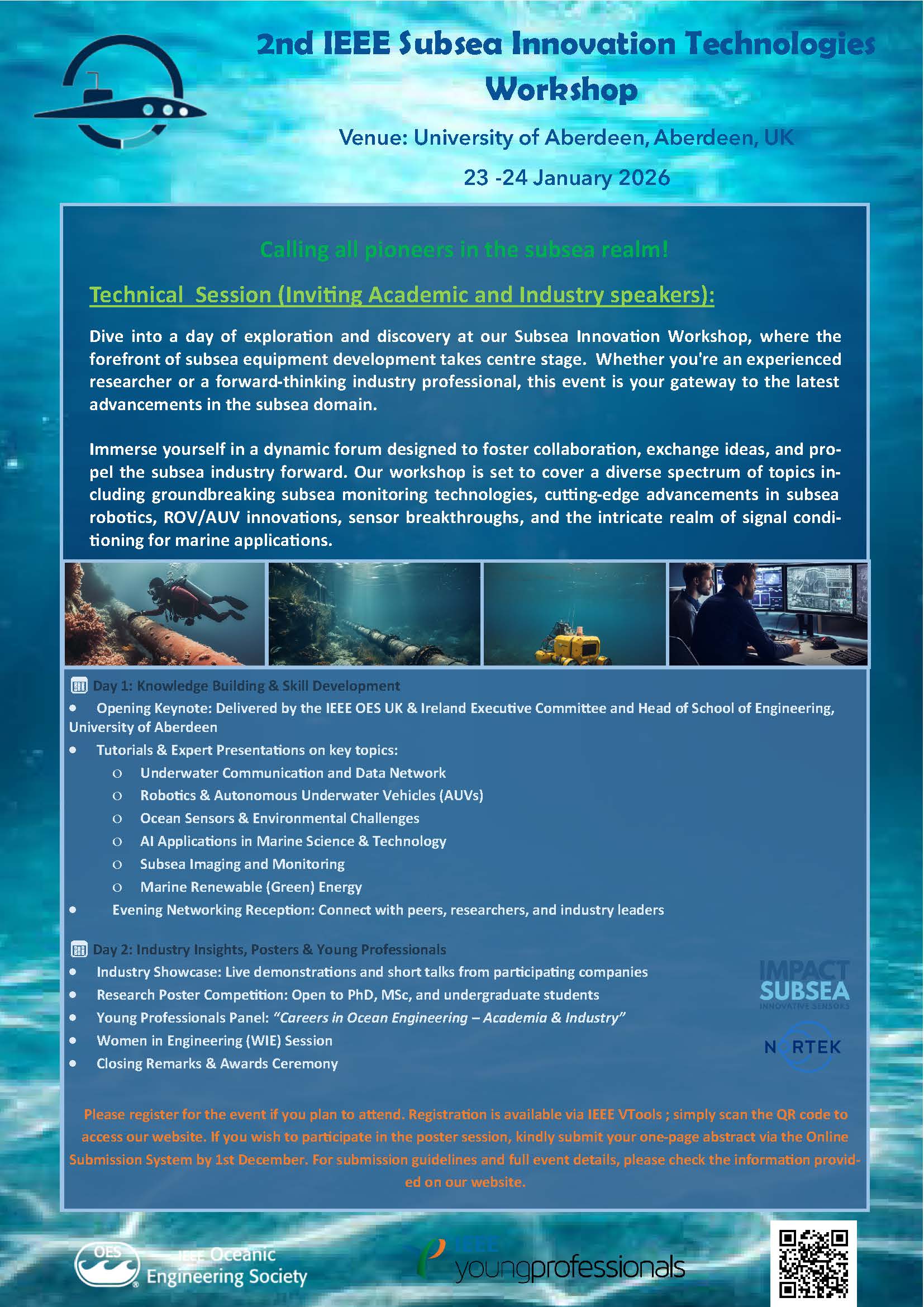
  • Winter School: 2nd IEEE Subsea Innovation Technologies Workshop

    University of Aberdeen

    The IEEE Oceanic Engineering Society is inviting to the 2nd IEEE Subsea Innovation Technologies Workshop to be held at the University of Aberdeen on 23rd and 24th January 2026.

    Alongside industry and academic presentations on the latest ocean and subsea technologies and innovations, students, young professionals and women in engineering are particularly encouraged to attend dedicated sessions and participate in the poster competition.

    Workshop website, registration ( it is a free event) and abstract submission: https://ieeeukiyp.org/SITW2026/

  • Aberdeen GameJam 2026

    Meston Building, University of Aberdeen Meston Walk, Aberdeen

    View full event details here. After the success of last year, University of Aberdeen’s School of Natural and Computing Sciences will be running Aberdeen GameJam 2026, this time in partnership with the History department! The event is open to students at University of Aberdeen and any other Scottish University. Each participant will receive an Aberdeen GameJam 2026 t-shirt and Amazon vouchers ... Read more

  • SICSA Seminar – From Large to Small: Building Affordable Language Models with Limited Resources

    AI + Data Science Seminar
    Virtual Event

    Register to attend Join us on Wednesday, 25 February for an AI & Data Science Seminar. Dr Burcu Can of University of Stirling presents From Large to Small: Building Affordable Language Models with Limited Resources This talk aims to question the limitations and harms of Large Language Models, followed by a review of Small Language Models, covering prominent ... Read more

  • LOCOS Seminar – Educating for Low-Carbon Computing: Designing a Cross-Layer Sustainable Computing Course in an HPC Curriculum with PedrocTrancoso

    LOCOS
    Online
    Virtual Event

    Lieven Eeckhout is a Professor at Ghent University, Belgium, and will deliver a LOCOS Seminar on Sustainable Processor Design.

    Sustainability and climate change is a major challenge for our generation. In this talk I will argue that sustainable development requires a holistic approach and involves multi-perspective thinking. Applied to computing, sustainable development means that we need to consider the entire environmental impact of computing, including raw material extraction, component manufacturing, product assembly, transportation, use, repair/maintenance, and end-of-life processing (disassembly and recycling/ reuse). Analyzing current trends reveals that the embodied footprint is, or will soon be, more significant compared to the operational footprint. I will present a simple, yet insightful, first-order model to assess and reason about the sustainability of processors in light of the inherent data uncertainty. Applying the model to a variety of case studies illustrates what computer architects and engineers can and should do to better understand the sustainability impact of computing, and to design sustainable processors.